
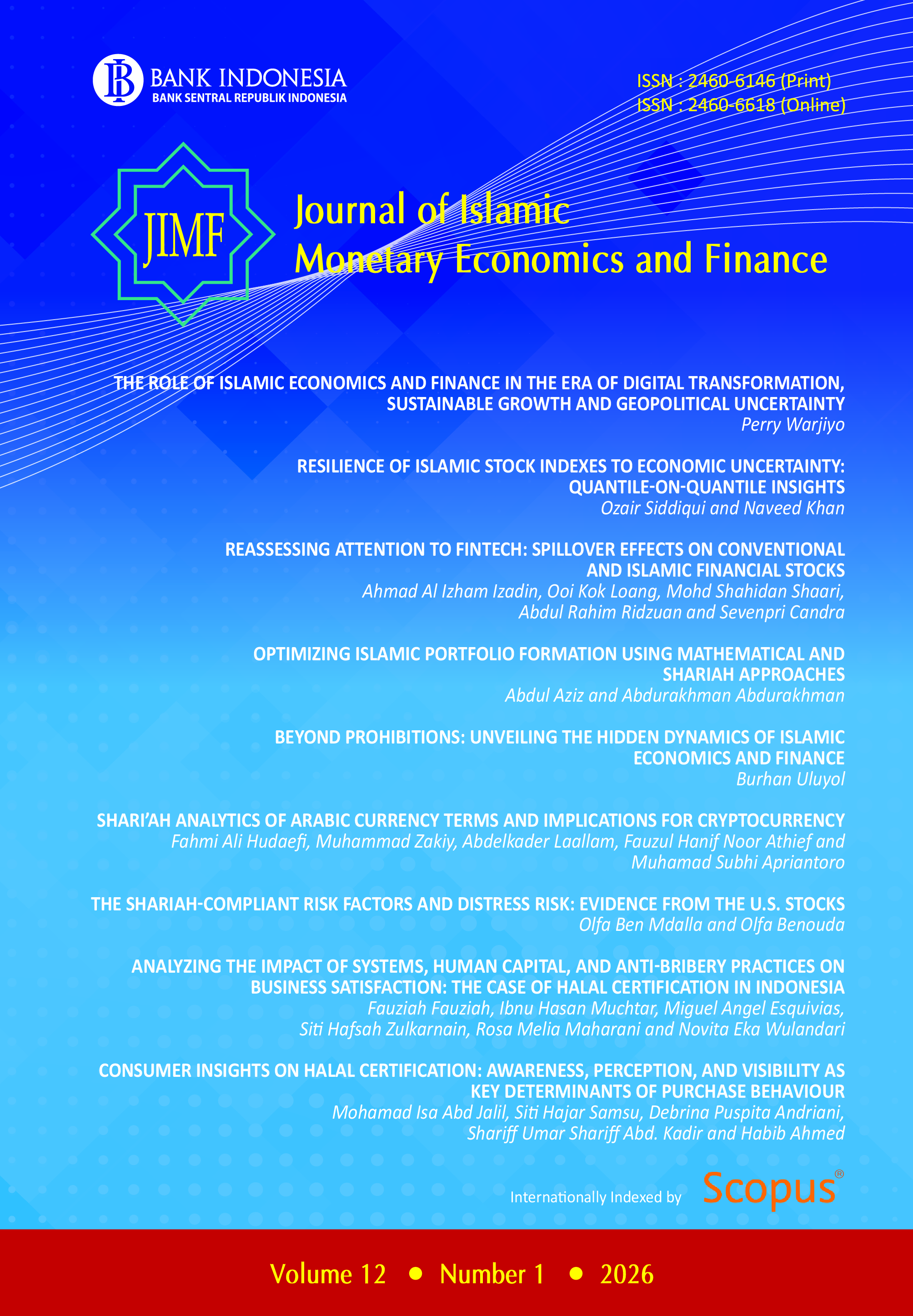
Consumer Insights on Halal Certification: Awareness, Perception, and Visibility as Key Determinants of Purchase Behaviour
Article Sidebar
 Read Counter : 3674
 Download : 2338

Main Article Content
Abstract
This study investigates consumer insights on halal certification in Malaysia by examining awareness, perception, visibility, trust, and purchase behaviour, with religious belief as a moderator. Using a non-probability purposive sampling method, 801 valid responses were collected and analysed with Partial Least Squares Structural Equation Modeling (PLS-SEM). The results show that perception and awareness significantly influence trust, while visibility has no significant effect. Trust and religious belief strongly predict purchase behaviour, and religious belief also moderates the relationship between trust and purchase. It should be noted, however, that the sample disproportionately represents Indigenous Sabah respondents, while Malay respondents—the national majority—are underrepresented. Therefore, the findings are context-specific and not generalisable to the entire Malaysian population. Despite this limitation, the study provides useful insights into consumer trust in halal certification and offers practical recommendations for practitioners, regulators, and policymakers, as well as theoretical contributions for future research.
Acknowledgment
This paper was supported by the Geran Penyelidikan Dana Kluster (DKP) Fasa 1/2023 (DKP0020). The authors gratefully acknowledge the financial support provided through this grant, which has facilitated the implementation of this research. The authors also sincerely thank the journal’s editors and reviewers for their valuable comments and suggestions that helped improve the quality of this paper.
Downloads
Article Details
Issue
Section

This work is licensed under a Creative Commons Attribution-NonCommercial 4.0 International License.

Journal of Islamic Monetary Economics and Finance is licensed under a Creative Commons Attribution-NonCommercial 4.0 International License.
References
Ab Talib, M. S., Rubin, L., & Zhengyi, V. K. (2013). Qualitative research on critical issues in halal logistics. Journal of Emerging Economies and Islamic Research, 1(2), 131-150.
Abd Jalil, M. I., Lada, S., Allah Pitchay, A., Bakri, M. A., Ghazali, M. F., & Abdul Hamid, M. R. (2022). Infaq during movement lockdown: The perspective from social responsibility theory. International Journal of Islamic and Middle Eastern Finance and Management, 15(2), 441–460.
Abd Jalil, M. I., Yahya, S., & Pitchay, A. A. (2022). The effect of information disclosure towards donor commitment: The case of waqf institution. Asian Academy of Management Journal, SE-Early Views-June 2023.
Abdul, M. (2014). Perceptions on Halal Food Certification in Hat Yai, Thailand. International Journal of Economics and Management, 8(1), 178-194.
Abdul, M., Ismail, H., Mustapha, M., & Kusuma, H. (2013). Indonesian small medium enterprises ( SMEs ) and perceptions on Halal food certification. African Journal of Business Management, 7(16), 1492–1500.
Ahmi, A., Mohd Nasir, M. H., & Mohd Sharif, M. H. (2005). E-Wakaf: Ke Arah Pengurusan Wakaf yang Lebih Sistematik [E-Wakaf: Towards More Systematic Waqf Management]. Seminar Kebangsaan Ke Arah Pembangunan E-Malaysia: Merapatkan Jurang Komuniti Dengan Teknologi Maklumat.
Ajzen, I. (1991). The theory of planned behavior. Organizational Behavior and Human Decision Processes, 50(2), 179–211.
Allah Pitchay, A., Sukmana, R., Ratnasari, R. T., & Abd Jalil, M. I. (2023). A study of cash waqf contribution between millennials of Malaysia and Indonesia. International Journal of Islamic and Middle Eastern Finance and Management, 16(4), 802-818.
Alserhan, B. A. (2010). On Islamic branding: Brands as good deeds. Journal of Islamic Marketing, 1(2), 101–106.
Amalia, A. N., Puspita, & Sardiana, A. (2018). The intention to pay on cash waqf based on religiosity and gender perspectives: An empirical studies. Proceedings of the 1st Unimed International Conference on Economics Education and Social Science, 1311–1316. https://doi.org/10.5220/0009497313111316
Anggraini, I. (2019). The effect of halal foods awareness on purchase decision with religiosity as a moderating variable (case study: Indonesian food consumer lived in Yogyakarta and Thailand). Economics, 6(1), 1-20.
Ascarya, & Tekdogan, O. F. (2022). Recommended methodology for research in Islamic Economics and Finance. In Teaching and research methods for Islamic Economics and finance (pp. 282–302). Routledge. https://doi.org/10.4324/9781003252764-22
Awan, H. M., Siddiquei, A. N., & Haider, Z. (2015). Factors affecting Halal purchase intention – evidence from Pakistan’s Halal food sector. Management Research Review, 38(6), 640–660.
Badruldin, B., Mohamed, Z., Sharifuddin, J., Rezai, G., Mahir Abdullah, A., Abd Latif, I., & Ghazali Mohayidin, M. (2012). Clients’ perception towards JAKIM service quality in Halal certification. Journal of Islamic Marketing, 3(1), 59–71.
Bashir, A. M. (2019). Effect of halal awareness, halal logo and attitude on foreign consumers’ purchase intention. British Food Journal, 121(9), 1998–2015.
Bernama. (2023). Frozen Food Company Slapped with RM1.5 million Fine for Using fake halal logo. The Malaysian Insight.
Bonne, K., Vermeir, I., Bergeaud-Blackler, F., & Verbeke, W. (2007). Determinants of halal meat consumption in France. British Food Journal, 109(5), 367–386.
Cheah, J.-H., Magno, F., & Cassia, F. (2024). Reviewing the SmartPLS 4 software: The latest features and enhancements. Journal of Marketing Analytics, 12(1), 97–107.
Chin, W. W. (1998). Issues and opinion on structural equation modeling. MIS Quarterly, 22(1), 7–16.
Cohen, J. (1988). Statistical Power Analysis for the Behavioral Sciences (2nd ed.). Lawrence Erlbaum Associates.
Dijkstra, T. K., & Henseler, J. (2015). Consistent partial least squares path modeling. MIS Quarterly, 39(2), 297–316.
Djakasaputra, A., Juliana, Aditi, B., Fachrurazi, & Mas’ad, M. A. (2023). The influence of halal certification, halal awareness, and brand image on interest in buying halal food products: An empirical study of consumers in Indonesia. International Journal of Islamic Business and Economics (IJIBEC), 7(2), 103–115.
El Ashfahany, A., Khansa Farrahvanaya, S., Subhi Apriantoro, M., & Suharjianto. (2024). Analysis of factors influencing intention to purchase halal Japanese food: The moderating role of religiosity. Innovative Marketing, 20(1), 66–76.
Euromeatnews. (2020). Fake Halal Meat Scandal Explodes in Malaysia. Euromeatnews. https://www.euromeatnews.com/Article-Fake-halal-meat-scandal-explodes-in-Malaysia-/4386
Fachrurrozie, F., Muhsin, Nurkhin, A., Mukhibad, H., & Daud, N. M. (2023). Determinants of halal food purchase decisions for Go Food and Shopee Food users. Innovative Marketing, 19(1), 113-125.
Fornell, C., & Larcker, D. F. (1981). Evaluating structural equation models with unobservable variables and measurement error. Journal of Marketing Research, 18(1), 39–50.
Gabrielyan, G., & Just, D. (2022). The effect of logo visibility on brand recognition and willingness to pay. Agricultural and Applied Economics Association (AAEA) Conferences, 18. https://doi.org/10.22004/ag.econ.322354
Hair, J. F., Hult, G. T. M., Ringle, C., & Sarstedt, M. (2021). A primer on partial least squares structural equation modeling (PLS-SEM) (3rd ed.). Sage Publications.
Hair, J. F., Matthews, L. M., Matthews, R. L., & Sarstedt, M. (2017). PLS-SEM or CB-SEM: Updated guidelines on which method to use. International Journal of Multivariate Data Analysis, 1(2), 107-123.
Hair, J. F., Risher, J. J., Sarstedt, M., & Ringle, C. M. (2019). When to use and how to report the results of PLS-SEM. European Business Review, 31(1), 2–24.
Hanafiah, M. H., & Hamdan, N. A. A. (2021). Determinants of Muslim travellers Halal food consumption attitude and behavioural intentions. Journal of Islamic Marketing, 12(6), 1197-1218.
Hazmi, F., & Utami, C. B. (2024). The role of halal awareness in affecting cosmetic purchase behavior. Ar Rehla: Journal of Islamic Tourism Halal Food Islamic Traveling and Creative Economy, 4(2), 157-172.
Hennington, A., Janz, B., Amis, J., & Nichols, E. (2009). Understanding the multidimensionality of information systems use: A study of nurses' use of a mandated electronic medical record system. Communications of the Association for Information Systems, 25(1), 243-262.
Henseler, J., Ringle, C. M., & Sarstedt, M. (2015). A new criterion for assessing discriminant validity in variance-based structural equation modeling. Journal of the Academy of Marketing Science, 43(1), 115-135.
Hosseini, A., Hooshanfar, K., Omrani, P., Toosi, R., Toosi, R., Ebrahimian, Z., & Akhaee, M. A. (2025). Brand visibility in packaging: A deep learning approach for logo detection, saliency-map prediction, and logo placement analysis. Discover Applied Sciences, 7(6), 537.
Identiti, I., Rimet, R., Suryadi, N., & Museliza, V. (2024). Halal label and purchasing decisions in fast food restaurants in Pekanbaru, Riau. INVEST : Jurnal Inovasi Bisnis dan Akuntansi, 5(1), 26–33.
Ishak, S., Awang, A. H., Hussain, M. Y., Ramli, Z., Md Sum, S., Saad, S., & Abd Manaf, A. (2016). A study on the mediating role of halal perception: Determinants and consequence reflections. Journal of Islamic Marketing, 7(3), 288–302.
Ismail, Z., & Hussein, Z. (2019). Regaining consumer trust over halal certification authority. In Contemporary Management and Science Issues in the Halal Industry: Proceedings of the International Malaysia Halal Conference (IMHALAL), May (pp. 43-52). Singapore: Springer Singapore.
Juliana, J., Rizaldi, M. W., Al-Adawiyah, R. A., & Marlina, R. (2022). Halal awareness: Pengaruhnya terhadap keputusan pembelian konsumen shopee dengan religiositas sebagai variabel moderasi. Jurnal Ilmiah Manajemen, 13(2), 169-180.
Jusmaliani, J., & Nasution, H. (2009). Religiosity aspect in consumer behaviour: Determinants of halal meat consumption. ASEAN Marketing Journal, 1(1), 1-13.
Khalek, A. A., & Mokhtar, R. A. M. (2017). With or without halal logo? A descriptive analysis of the generation Y perceptions on the national halal certification Malaysia. Asia Pacific Journal of Advanced Business and Social Studies, 3(1), 242-249.
Khan, M. I., & Haleem, A. (2016). Understanding “halal” and “halal certification & accreditation system”-a brief review. Saudi Journal of Business and Management Studies, 1(1), 32-42.
Knuth, M., Behe, B. K., Hall, C. R., Huddleston, P. T., & Fernandez, R. T. (2018). Consumer perceptions, attitudes, and purchase behavior with landscape plants during real and perceived drought periods. HortScience, 53(1), 49–54.
Koc, F., Ozkan, B., Komodromos, M., Efendioglu, I. H., & Baran, T. (2025). The effects of trust and religiosity on halal products purchase intention: indirect effect of attitude. EuroMed Journal of Business, 20(5), 141-165.
Lada, S., Harvey Tanakinjal, G., & Amin, H. (2009). Predicting intention to choose halal products using theory of reasoned action. International Journal of Islamic and Middle Eastern Finance and Management, 2(1), 66–76.
Lau, T. C., Choe, K. L., & Tan, L. P. (2013). The moderating effect of religiosity in the relationship between money ethics and tax evasion. Asian Social Science, 9(11), 213-220.
Lombart, C., Millan, E., Normand, J. M., Verhulst, A., Labbé-Pinlon, B., & Moreau, G. (2019). Consumer perceptions and purchase behavior toward imperfect fruits and vegetables in an immersive virtual reality grocery store. Journal of Retailing and Consumer Services, 48, 28-40.
Mahliza, F., & Aditantri, R. (2022). Consumption behavior of halal cosmetic products: The mediating role of trust on the effect of halal certification on purchase intention. Journal of Economics, Finance and Management Studies, 5(1), 228-239.
Maifiah, M. H. M., Ahmad, A. N., Azam, M. S. E., Norazmi, A. R. M., & Nawawi, K. A. (2022). Malaysian Muslim consumers’ awareness, confidence, and purchase behaviour on halal meat and its products after the meat cartel scandal. Food Research, 6(6), 273–279.
Marso, & Hasan, H. (2020). Religiosity and its consequences in halal food purchasing behaviour: An empirical evidence from Tarakan, Indonesia and Tawau, Malaysia. Journal of the Asian Academy of Applied Business (JAAAB), 6, 1-15.
Marzuki, S. Z. S., Hall, C. M., & Ballantine, P. W. (2012). Restaurant managers’ perspectives on halal certification. Journal of Islamic Marketing, 3(1), 47–58.
Maulida, R., Nawawi, K., & Arif, S. (2024). Impact of consumer awareness and halal certification on purchase decision. Islamic Economics Methodology, 3(2), 1-16.
Memon, M. A., Cheah, J. H., Ramayah, T., Ting, H., Chuah, F., & Cham, T. H. (2019). Moderation analysis: Issues and guidelines. Journal of Applied Structural Equation Modeling, 3(1), 1-11.
Miftahuddin, M. A., Adawiyah, W. R., Pradipta, R., & Wihuda, F. (2022). Examining the effect of halal perceived value and perceived risk on purchase intention: A mediating role of halal trust. Innovative Marketing, 18(4), 62–73.
Milah, J., Rahayu, F. A., Deswita, R., & Fatimah, W. S. (2024). Pengaruh halal awarness dan label halal terhadap keputusan pembelian konsumen. AL-MUSAHAMAH: Journal of Islamic Economics, Finance, and Business, 1(1), 64-73.
Ministry of Investment Trade and Industry. (2023). New Industrial Master Plan 2030. Ministry of Investment Trade and Industry.
Muhammad, M. A., Elistina, A. B., & Ahmad, S. O. (2020). The challenges faced by halal certification authorities in managing the halal certification process in Malaysia. Food Research, 4(1), 170-178.
Mujanah, S. (2024). Challenges and opportunities of implementing halal certification in nonmuslim majority markets. Journal of Halal Research, Policy, and Industry, 3(1), 32-38.
Mustaqim, D. Al, & Fazriani, D. (2023). Analysis of the effect of halal certification on consumer trust and brand loyalty. Center for Open Science. https://doi.org/10.31219/osf.io/9d3jg
Mustun, I. Z. K. (2022). Enhancing buyer-supplier relationship in the Halal fast food sector in Mauritius: The role of trust. International Journal of Islamic Business (IJIB), 7(1), 32-50.
Najmudin, & Ahyakudin. (2024). Behavioral interest in purchasing halal products: Exploring an extended theory of planned behavior effect. Journal of Islamic Economics and Finance Studies, 5(1), 117–133.
Nawawi, S. Bin, Roslin, R. B. M., & Abdul Hamid, N. B. (2018). Customers’ intention to repurchase halal personal care products: the moderating role of religiosity. Proceedings of the 2nd Advances in Business Research International Conference, October (pp. 39–54). Springer Singapore.
New Straits Times. (2025). UM Shuts 2 campus shops over halal sandwich concerns. New Straits Times.
Nugroho, A. A., Pratala, E., & Atikah, A. (2021). Halal certification models in increasing community purchase intention for halal products in Indonesia. International Journal of Business, Technology, and Organizational Behavior, 1(1), 23-34.
Nunnally, J. C., & Bernstein, I. H. (1994). Psychometric theory (3rd ed.) (3rd ed.). McGraw Hill.
Pantano, E. (2011). Cultural factors affecting consumer behaviour: A new perception model. EuroMed Journal of Business, 6(1), 117–136.
Pauzi, N., Razali, A., Syed Jaafar, S. M. J., Jamaludin, M. H., Mohd Razif, N. F., & Man, S. (2022). Religiosity as a mediator in the relationship between perceived behavioural control and intention in patronising halal food premises. Food Research, 6(5), 300–309.
Pratiwi, D. P., & Falahi, A. (2023). Pengaruh sertifikasi halal dan kesadaran halal terhadap keputusan pembelian produk kosmetik wardah di Desa Bangun Rejo Tanjung Morawa. Jurnal Bisnis, Manajemen, dan Akuntansi, 10(1), 1-13.
Quoquab, F., Mohamed Sadom, N. Z., & Mohammad, J. (2020). Driving customer loyalty in the Malaysian fast food industry: The role of halal logo, trust and perceived reputation. Journal of Islamic Marketing, 11(6), 1367-1387.
Rafiki, A., Hidayat, S. E., & Nasution, M. D. T. P. (2024). An extensive effect of religiosity on the purchasing decisions of halal products. PSU Research Review, 8(3), 898-919.
Said, M., & Hasim, M. A. (2022). The mediating role of consumers’ trust towards consumers’ purchase intention of halal food from Malaysia: Application of structural equation modelling. Journal of Halal Service Research, 3(1), 10-21.
Saiman, M. Z., & Yusma, N. S. (2022). Issues and challenges of promotion halal certification for Muslim entrepreneurs in Malaysia. Al-Qanatir International Journal of Islamic Studies, 28(2), 116–128.
Saleh, H., & Rajandran, T. (2024). Relationship between non-Muslim consumer intention to purchase halal products with halal awareness, halal certification, halal marketing and halal knowledge: Systematic review. International Journal of Academic Research in Business and Social Sciences, 14(9), 416-426.
Saputro, E. P., & Seyaningrum, D. P. (2023). Research on the millennial generation’s behavior toward halal consumption. Maker: Jurnal Manajemen, 9(1), 14-26.
Sayyed Hosseini, S. M., Salari, T. E., & Zaman Abadi, S. M. N. (2014). Study of cash waqf and its impact on poverty: Case study of Iran. Atlantic Review of Economics, 2(1), 1-19.
Setiawan, S., & Mauluddi, H. A. (2020). An examination of purchasing intention towards halal products. International Journal of Economics and Management Systems, 5, 209–216.
Shaari, J. A. N. B., Khalique, M., & Ottot, H. B. (2021). Halal Logo and the confidence level of Malaysian customers on Indonesian halal certified products. Academy of Entrepreneurship Journal, 27(5), 1-8.
Shafie, S., & Othman, M. N. (2006). Halal certification: An international marketing issues and challenges. Proceeding at the International IFSAM VIIIth World Congress, (pp. 28-30).
Shah Alam, S., & Mohamed Sayuti, N. (2011). Applying the theory of planned behavior (TPB) in halal food purchasing. International Journal of Commerce and Management, 21(1), 8-20.
Salmah, S., & Shikur, A. A. (2023). The relationship of attitude, perceived behavioral control, subjective norm on halal food purchasing behavior on Indonesian Muslim millennials. Ekonomi Islam Indonesia, 5(1), 1-14.
Sidanti, H., Asmike, M., & Alkarimy, N. M. M. (2023). The influence of halal certification and religiosity on interest in buying mixue products through attitude as an intervening variable (study of communities in Madiun City). International Journal of Science, Technology & Management, 4(5), 1188-1196.
Soto-Acosta, P., Popa, S., & Palacios-Marqués, D. (2016). E-business, organizational innovation and firm performance in manufacturing SMEs: An empirical study in Spain. Technological and Economic Development of Economy, 22(6), 885-904.
Spence, M. (1973). Job market signaling. The Quarterly Journal of Economics, 87(3), 355-374.
Tieman, M., & Ghazali, M. C. (2014). Halal control activities and assurance activities in halal food logistics. Procedia-Social and Behavioral Sciences, 121, 44-57.
Umair, T., Naeem, H. M., & Rashid, M. A. (2024). Role of extrinsic and intrinsic religiosity on muslim consumer purchase intention toward religiously sanctioned food evidence from non-muslim state. Research Journal for Societal Issues, 6(2), 267-285.
Wee, C. S., Ariff, M. S. B. M., Zakuan, N., Tajudin, M. N. M., Ismail, K., & Ishak, N. (2014). Consumers perception, purchase intention and actual purchase behavior of organic food products. Review of Integrative Business and Economics Research, 3(2), 378-397.
Wijayanti, R., & Meftahudin, M. (2018). Kaidah fiqh dan ushul fiqh tentang produk halal, metode istinbath dan ijtihad dalam menetapkan hukum produk halal. International Journal Ihya’ ’Ulum Al-Din, 20(2), 241–268.
Wilson, J. A. J., & Liu, J. (2011). The challenges of Islamic branding: Navigating emotions and halal. Journal of Islamic Marketing, 2(1), 28–42.
Yanti, V. S. (2024). Exploring halal certification and impact on business for MSME’s. Journal of Halal Research, Policy, and Industry, 3(1), 1-8.
Zafar, M. B., & Abu-Hussin, M. F. (2025). Halal purchasing decisions and consumer behavior: A multi method review. Journal of Islamic Marketing, 16(9), 2703-2732.
Zailani, S., Omar, A., & Kopong, S. (2011). An exploratory study on the factors influencing the non-compliance to halal among hoteliers in Malaysia. International Business Management, 5(1), 1-12.
Zhu, Y., Chen, Y. P., Ayed, C., Li, B., & Liu, Y. (2020). An on-line study about consumers’ perception and purchasing behavior toward umami seasonings in China. Food Control, 110, 107037.
Zion Market Research. (2023). Global halal food market size is predicted to grow to around USD 4115.87 million by 2030. Zion Market Research. https://www.zionmarketresearch.com/news/global-halal-food-market.
Zuhudi, N. W. M., & Dolah, J. (2021). The recognition of Islamic influence for halal logo: A review. Jurnal Gendang Alam (GA), 11(2), 207-218.
Zulkfli, N., Abdullah, N., & Mat Issa, Z. (2023). The moderating effect of halal certification on the purchase intention of halal bakery products in Petaling district, Selangor, Malaysia. Food Research, 7(4), 137–145.