
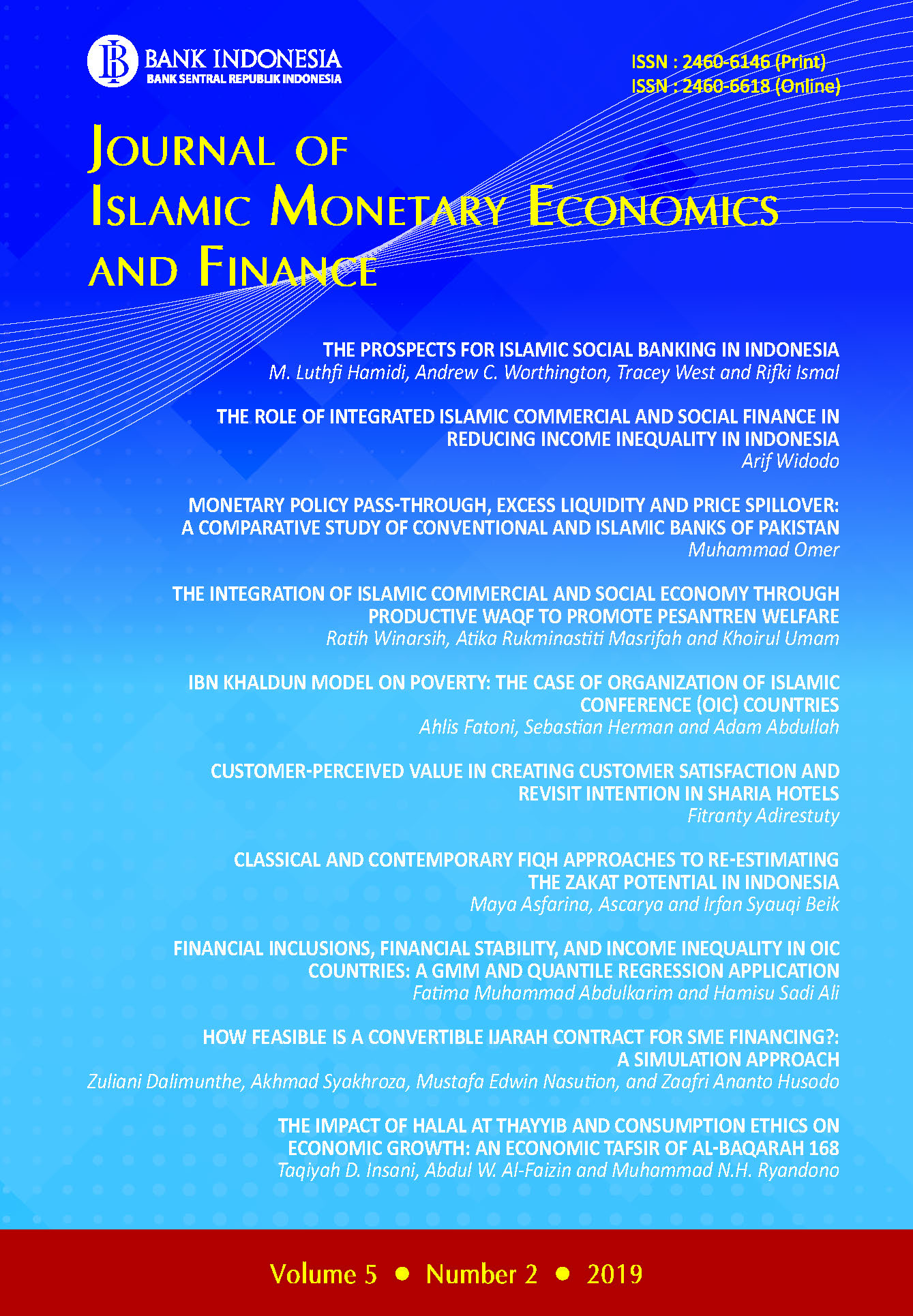
Financial Inclusions, Financial Stability, and Income Inequality in OIC Countries: A GMM and Quantile Regression Application
Article Sidebar
Published:
2019-07-24
Keywords:
Financial Inclusion, Financial Stability, Income Inequality, OIC Countries, GMM, Quantile Regression
Statistics
 Read Counter : 3741
 Download : 3038
Read Counter : 3741
Download : 3038
Crossmark/ Data Version

Main Article Content
Abstract
This paper examines the relationship among financial inclusion, financial stability, and income inequality in some selected Organization of Islamic Corporations (OIC) countries. Data were analyzed using dynamic panel estimation and quantile regression for 47 OIC countries during 2006 - 2016. The results of dynamic GMM reveal that financial inclusion has a positive and significant effect on both financial stability and income inequality. This implies that increased financial access helped narrow the gap between the rich and poor as well as provided financial stability in OIC countries. Therefore, policy makers should strive to design policies that will make financial services more available and affordable to the masses. Thus, it is safe to conclude that availability of both Islamic and conventional finances in OIC countries contributes positively to the development of the countries.
Downloads
Download data is not yet available.
Article Details
How to Cite
[1]
Abdulkarim, F.M. and Ali, H.S. 2019. Financial Inclusions, Financial Stability, and Income Inequality in OIC Countries: A GMM and Quantile Regression Application. Journal of Islamic Monetary Economics and Finance. 5, 2 (Jul. 2019), 419–438. DOI:https://doi.org/10.21098/jimf.v5i2.1069.
Issue
Section
Articles

This work is licensed under a Creative Commons Attribution-NonCommercial 4.0 International License.

Journal of Islamic Monetary Economics and Finance is licensed under a Creative Commons Attribution-NonCommercial 4.0 International License.