
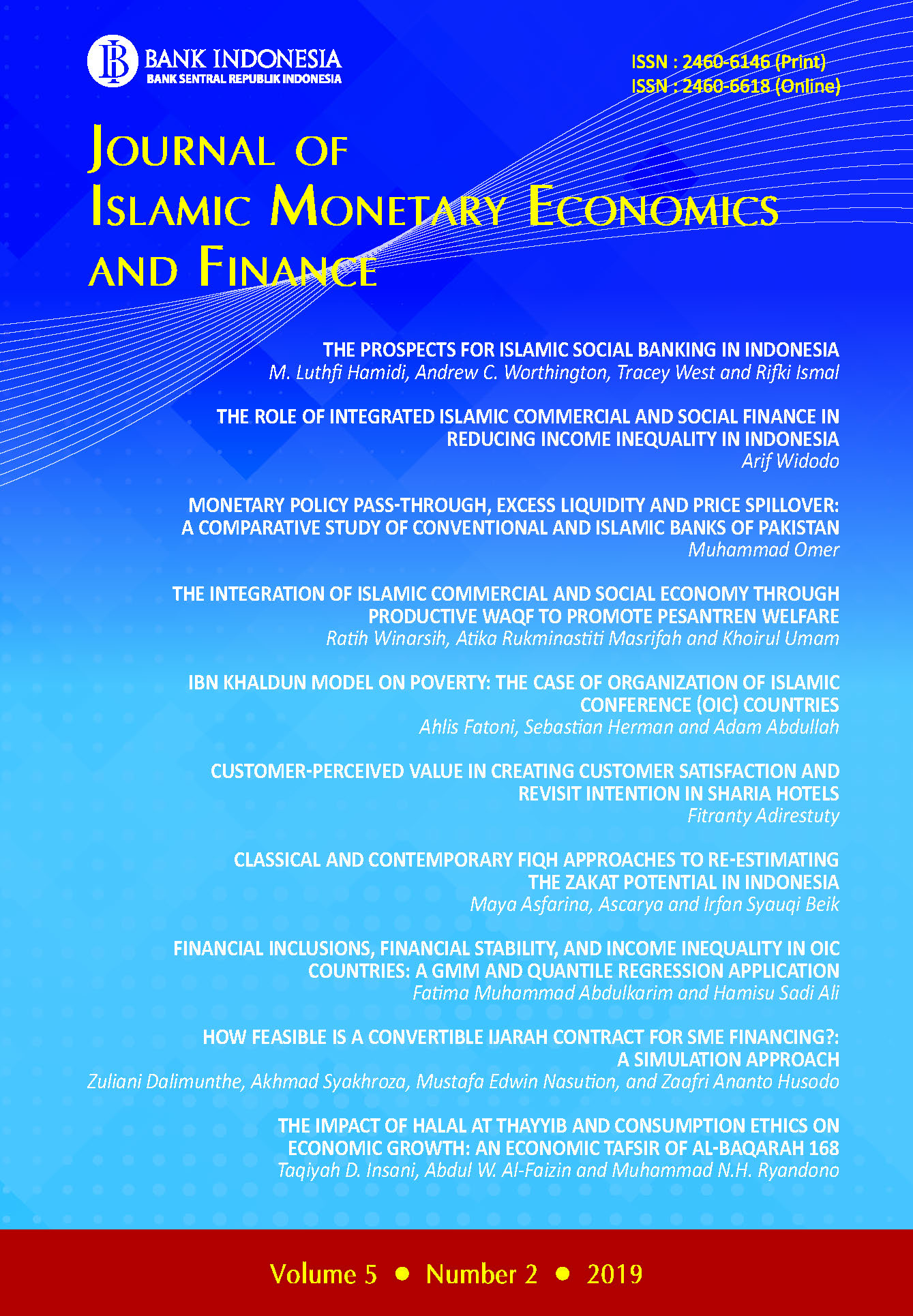
The Prospects for Islamic Social Banking in Indonesia
Article Sidebar
Published:
2019-07-23
Keywords:
Islamic Banking, Islamic Social Banking, Quadruple Bottom Line, Social Outcomes, ZIS-Waqf
Statistics
 Read Counter : 4089
 Download : 3356
Read Counter : 4089
Download : 3356
Crossmark/ Data Version

Main Article Content
Abstract
Despite significant growth and development in recent years, Islamic banking (IB) continues to face widespread criticism due to its apparently weak social outcomes. This study investigates the social performance of Islamic banking in Indonesia, including its justification as an IB objective and the means of improvement. We surveyed 506 current and potential Islamic banking customers across six Indonesian provinces, combined with in-depth interviews with 10 Islamic banking experts consisting of regulators, practitioners, Sharia scholars, and academics. The findings strengthen previous results on the topic in that 42.89% of respondents consider that IB in Indonesia is socially defensive (doing the least that is required in terms of social outcomes), while 6.92% believe that it is reactive (doing less than that required). Of the remaining respondents, 34.78% consider the social performance as accommodative (doing all that is required) and 15.42% see it as proactive (doing more than is required). Most respondents (52.96%) suggest improvement by combining corporate social responsibility and the ZIS (Zakat, Infaq, shadaqah)- Waqf system. Only some (7.11%) suggest the establishment of Islamic social banking, whose main feature would be to design an alternative to collateral so that low- and middle-income customers could more readily access bank financing. We recommend that regulators and practitioners take action to address these challenges through incentives and long-term strategic planning.
Downloads
Download data is not yet available.
Article Details
How to Cite
[1]
Hamidi, M.L. et al. 2019. The Prospects for Islamic Social Banking in Indonesia. Journal of Islamic Monetary Economics and Finance. 5, 2 (Jul. 2019), 237–262. DOI:https://doi.org/10.21098/jimf.v5i2.1062.
Issue
Section
Articles

This work is licensed under a Creative Commons Attribution-NonCommercial 4.0 International License.

Journal of Islamic Monetary Economics and Finance is licensed under a Creative Commons Attribution-NonCommercial 4.0 International License.