
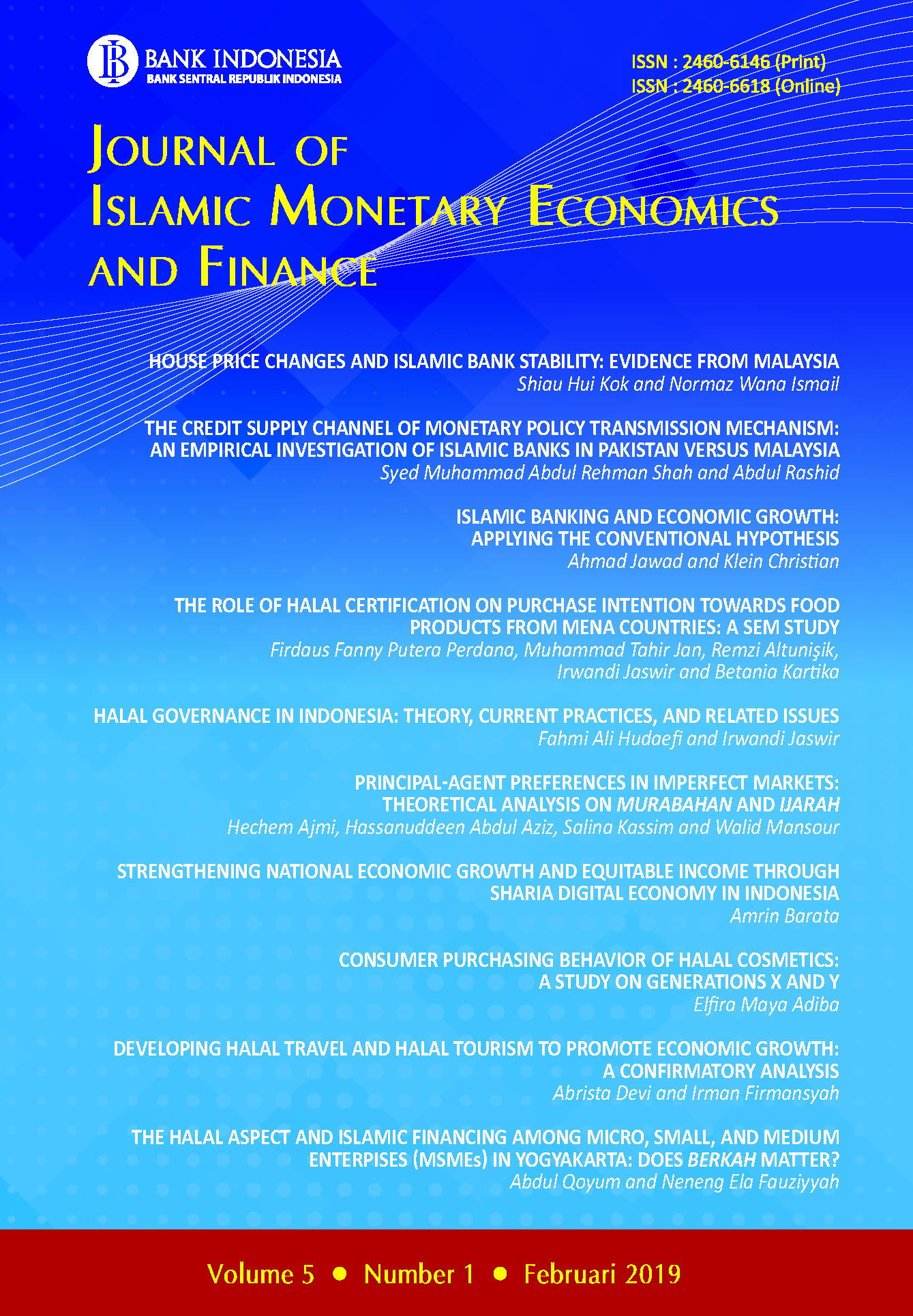
The Credit Supply Channel of Monetary Policy Transmission Mechanism: An Empirical Investigation of Islamic Banks in Pakistan versus Malaysia
Article Sidebar
Published:
2019-05-16
Keywords:
Credit Supply Channel, Loan Supply, Monetary Policy, Bank Lending Channel, Islamic Banks, Transmission Mechanism
Statistics
 Read Counter : 3057
 Download : 2404
Read Counter : 3057
Download : 2404
Crossmark/ Data Version

Main Article Content
Abstract
The transmission mechanism of monetary policy is explained through the relationships between a change in money supply and the level of real income. Monetary policy transmits to the real sector through several different channels. Such channels include the interest rate channel, the exchange rate channel, the asset-pricing channel, the credit supply channel, and the bank balance sheet channel. This paper empirically investigates the credit supply channel of monetary policy and explores the differential impact of monetary policy on credit supply of Islamic banks in Pakistan versus Malaysia. The robust two-step System-Generalize Method of Moments (GMM) estimator is applied on an unbalanced panel dataset over the period 2005-2016. While estimating the effects of three alternative measures of monetary policy on banks’ credit supply, several bank-specific variables are included in the specification as control variables. We provide strong evidence on the existence of credit supply channel in the baseline models for both countries and differential impact of monetary policy through Islamic banks in Pakistan versus Malaysia in the extended models. Our findings suggest that there is a vital need to consider the nature of Islamic banks while devising the instruments of an effective monetary policy in countries with dual banking system like Pakistan, Malaysia, Indonesia, Bahrain, Saudi Arabia, Qatar and others.
Downloads
Download data is not yet available.
Article Details
How to Cite
[1]
Shah, S.M.A.R. and Rashid, A. 2019. The Credit Supply Channel of Monetary Policy Transmission Mechanism: An Empirical Investigation of Islamic Banks in Pakistan versus Malaysia. Journal of Islamic Monetary Economics and Finance. 5, 1 (May 2019), 21–36. DOI:https://doi.org/10.21098/jimf.v5i1.1046.
Issue
Section
Articles

This work is licensed under a Creative Commons Attribution-NonCommercial 4.0 International License.

Journal of Islamic Monetary Economics and Finance is licensed under a Creative Commons Attribution-NonCommercial 4.0 International License.