

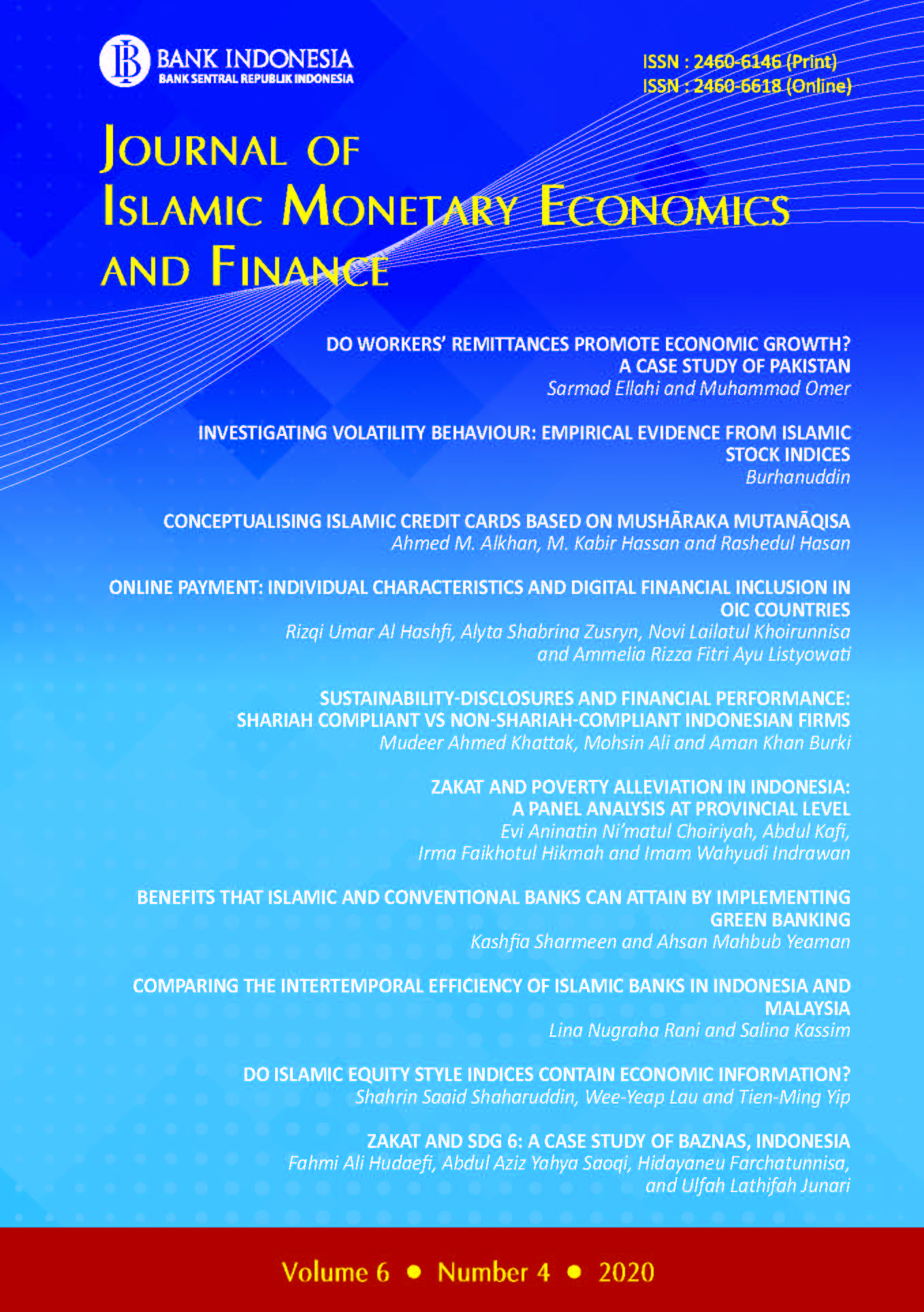
DO WORKERS’ REMITTANCES PROMOTE ECONOMIC GROWTH? A CASE STUDY OF PAKISTAN
Article Sidebar
 Read Counter : 1813
 Download : 1470

Main Article Content
Abstract
This study investigates the role of workers’ remittances in promoting economic growth in Pakistan, using data from 1976-2017. Remittances are an important source of Sharia-compliant (mostly) FX inflows, which may contribute to the economic development of many Islamic and non-Islamic economies. Nonetheless, they are more relevant to Islamic economies, as they could potentially reduce the requirements of interest-based FX financing from donor agencies and/or from global capital markets. The impact of workers’ remittances on the economic growth of Islamic developing economies remains a little explored area. Our research, which employs a case study of Pakistan, is first in this direction. We used the GMM estimation procedure to obtain efficient estimates in the presence of endogeneity and simultaneity bias. Our estimates show that an increase in remittance inflows positively affects the economic growth of Pakistan. The increase in per capita GDP could be primarily due to an increase in the consumption of low-income recipients. It is likely that this consumption demand promotes investment activity; however, the study could not establish the impact of remittances on such activity.
Downloads
Article Details
Issue
Section

Journal of Islamic Monetary Economics and Finance is licensed under a Creative Commons Attribution-NonCommercial 4.0 International License.