

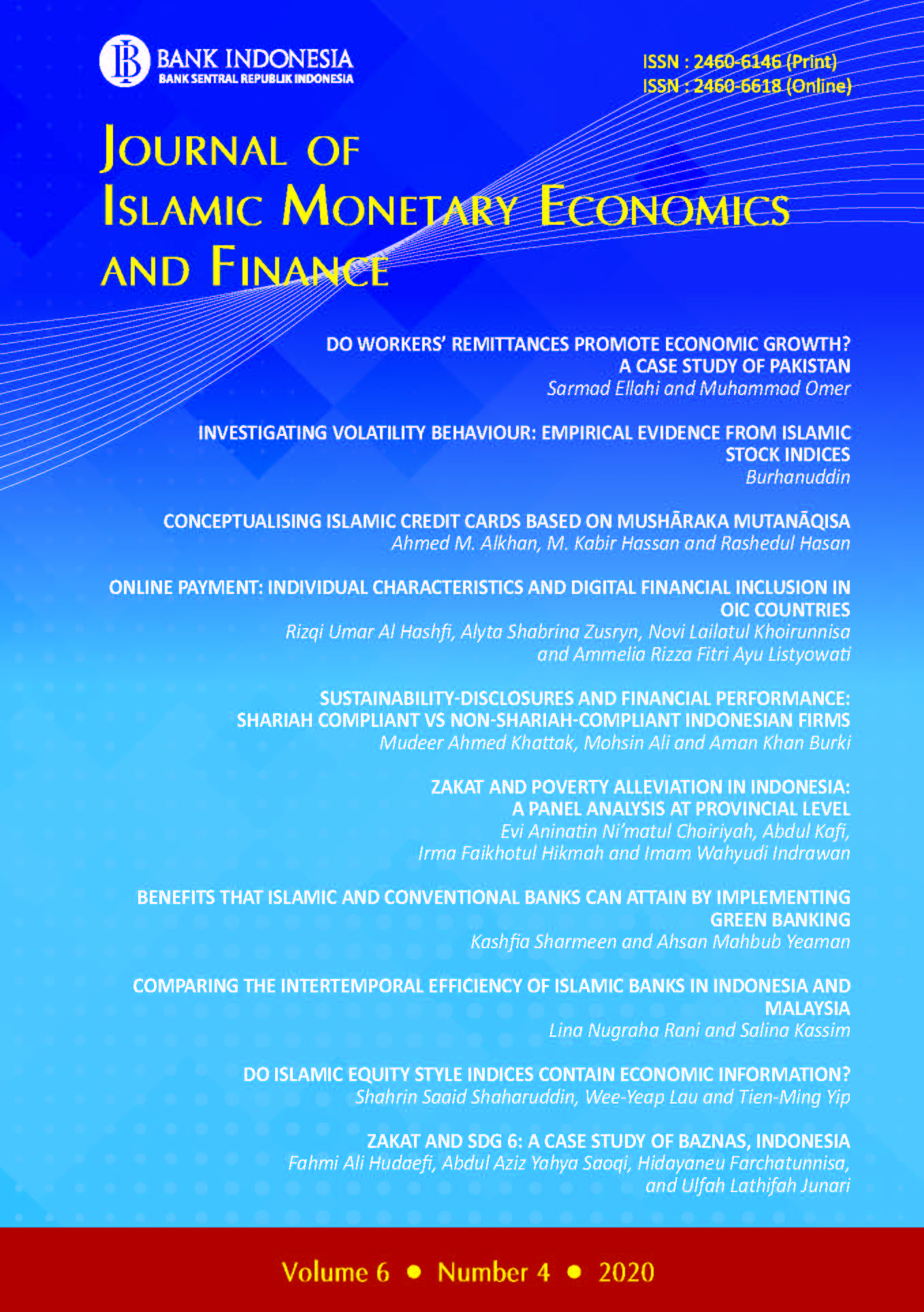
ONLINE PAYMENT: INDIVIDUAL CHARACTERISTICS AND DIGITAL FINANCIAL INCLUSION IN OIC COUNTRIES
Article Sidebar
 Read Counter : 2604
 Download : 2122

Main Article Content
Abstract
Digital financial inclusion (DFI) is a prominent issue in the digital era, since it focuses on the use of technology to serve unbanked people at low cost. The adoption of mobile money platforms that allow users to make efficient peer-to-peer and real-time transactions is one aspect of the DFI agenda. This study aims to investigate the determinants of mobile money usage using data derived from the 2017 Global Financial Inclusion survey conducted by the World Bank and Gallup and applying probit regression and the Heckman selection model to check robustness. Even though access to a financial institution is relatively low, the percentage of mobile money usage in Organisation of Islamic Cooperation (OIC) countries is slightly higher than in non-OIC countries and worldwide. The rate of adoption of mobile money is higher for individuals making online transactions, with more educated and more prosperous males tending to be more included in the use of digital financial services. The U-shape hypothesis for the relationship between age and the use of mobile money is not supported. Our research contributes to the theoretical development of the Unified Theory of Acceptance and Use of Technology 2 in illustrating the use of mobile technology. The empirical results are recommended for use by practitioners, regulators and policymakers in creating and fostering a sound ecosystem for digital finance development.
Downloads
Article Details
Issue
Section

Journal of Islamic Monetary Economics and Finance is licensed under a Creative Commons Attribution-NonCommercial 4.0 International License.